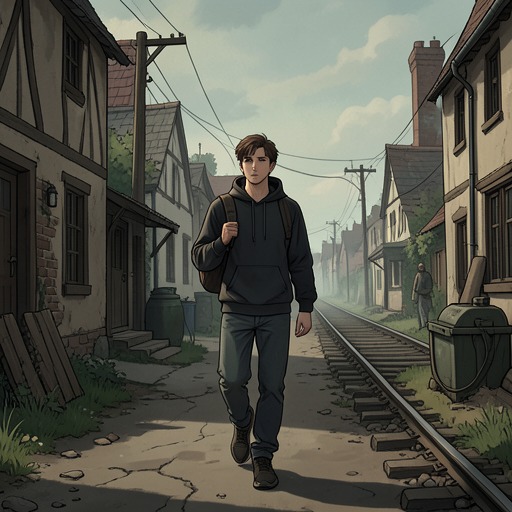
Patrick Casati
And Their Children After ThemPatrick Casati is Anthony Casati’s father: a practical, physically capable man whose efforts to provide for his family and rebuild his life are repeatedly undermined by heavy drinking, unemployment, and anger. He can be protective and affectionate, yet his violence has lasting consequences for both families and for himself. His arc moves between work and idleness, sobriety and relapse, and the hope of being close to Anthony Casati and the growing distance that separates them.
Identity and Background
Patrick Casati belongs to a generation shaped by the closure of the blast furnaces and the scarcity of work in the valley. After the furnaces shut down, he and Luc Grandemange worked at the Rexel warehouse. They were among men who left their former employment voluntarily and retrained as forklift operators. The training initially seemed promising, even enjoyable, but it did not secure Patrick Casati’s future. He eventually lost both his job and his driver’s license on the same day, in connection with his drinking; he recovered the license after six months of administrative difficulties and treatment with the Croix Bleue.
Practical work was central to how Patrick Casati understood himself. His parents had little schooling, and he left school at fourteen. He learned to cut wood, build fires, lay tiles, repair faucets and roofs, maintain a garden, and do basic carpentry. He and his brothers spent much of their youth outdoors, gathering mushrooms and berries and learning to ski through Catholic youth programs. He was raised to distrust idleness and indoor, desk-bound work. Later, when he found himself alone and underemployed, the unused strength in his hands became a source of distress: he wanted to handle tools and make things, but could not find a stable way to put that capacity to use.
Work, Family, and Anger
After work became scarce, Patrick Casati tried to support his household through small jobs. He bought an Iveco dump truck, a mower, tools, and coveralls embroidered with his name, and took mostly informal work. In good months he could earn four or five thousand francs. His earnings, combined with Hélène Casati’s salary, generally kept the family afloat. Summer brought more work, and he made Anthony Casati help mow lawns and clean swimming pools; that help was especially valuable when Patrick Casati had a hangover. The arrangement made his son part of the family’s practical economy, but also brought the consequences of his drinking into their daily life.
At home, his anger could be set off by something as small as a smudge on the television screen. In its aftermath, he recognized that he had gone too far but found it difficult to apologize directly. Instead, he would lower his voice and offer to dry the dishes, trying to regain forgiveness through small acts of service. Hélène Casati left to stay with her sister several times, then returned to a household that resumed its routines without resolving the weight between them. The cycle of rupture and return left family life burdened even when no argument was taking place.
Patrick Casati’s relationship with Anthony Casati carries the same mixture of warmth and threat. Anthony Casati loves his father and wants to please him; he enjoys working outdoors with him and values the rare occasions when Patrick Casati is satisfied. After one night when the cousins stayed out, Patrick Casati was calm enough to acknowledge that he had spoken wrongly, and he spoke of his problems with Hélène Casati. But he also warned Anthony Casati that another such absence would bring punishment, mentioning how distressed his mother had been. The tenderness of their attachment does not erase the fear and volatility that shape it.
Sobriety, Routine, and Control
Quitting alcohol once required a severe physical and emotional adjustment. Patrick Casati endured two months of headaches, aches, night sweats, disturbed sleep, and episodes of crying and shouting before he woke one morning feeling that the withdrawal had passed. He slept better and felt physically improved, though eating sweets made him gain weight. Sobriety did not simply restore him: it also removed the familiar rush of the first drinks and left him facing time, boredom, and other people without the habits that had structured his days.
For a while, he tried to build a sober routine. Living alone in a small apartment after separating from Hélène Casati, he spent long stretches feeling directionless and complaining about money, his wife, Anthony Casati, and the sense that he had wasted his youth. He eventually bought a bicycle, rode beside the canal, and sat watching the water. He also began saving the twenty or thirty francs he would otherwise have spent on alcohol. Ten months later, the jar held more than five thousand francs. The small accumulation gave saving a visible form and became the basis of a plan to give Hélène Casati a present.
He found work through Adecco at Districan, with a permanent contract and a monthly wage just under seven thousand francs, as well as a meal allowance, paid vacation, and health coverage. His route work required him to collect money from vending machines, clean and restock them, and scan a magnetic badge at each stop. At home he connected the scanner to a telephone line so that the information could be sent to Districan’s database. The data helped the company organize service and invoices, but also monitor work pace, downtime, routes, and costs. The job offered routine and relative security while making his labor measurable.
The company uniform became a point of resistance. Patrick Casati accepted the branded shirt and jacket but refused to wear the soft red cap. A supervisor repeatedly caught him working bareheaded and pressed him about the rule. Patrick Casati argued that the cap would not help him meet his quota and that no one could see him. His refusal was small beside the scale of his economic dependence, but it exposed his unwillingness to submit to a demand he considered pointless. After his separation, his life had become simplified into repeated meals, clothes, and days; the cap was one of the few things he still chose to contest.
Violence and Its Consequences
The confrontation with Hacine Bouali turns Patrick Casati’s accumulated frustration into a decisive act of violence. When Patrick Casati enters and sees Anthony Casati and Hacine Bouali together, the history of the motorcycle, its theft, and the divorce seems to him to form a single chain. He strikes Hacine Bouali. The blow is not presented as a considered response to the immediate scene; it carries the weight of old grievances, disappointments, and wasted years. That interpretation explains the force of the moment without excusing the choice Patrick Casati makes.
The attack costs him heavily. He stands trial, and Hacine Bouali’s father, Bouali, is called to testify. Patrick Casati avoids prison, but legal costs, a fine, and the loss of his job leave him deeply indebted. The family fears the prospect of imprisonment until the outcome is known, and the financial consequences compound the strain already produced by the divorce. Anthony Casati recognizes the severity of the punishment as well as its social force: Patrick Casati is left effectively excluded, with debts that he cannot realistically repay. His violence has not restored authority or repaired the past; it has narrowed his remaining choices.
Decline, Attachment, and Ending
In later years, Patrick Casati lives on welfare in a studio apartment and works twelve hours a week at minimum wage for a private building manager. His tasks include cleaning, taking out garbage, and mowing lawns; residents sometimes ask him to make small repairs and give him tips. He receives a housing subsidy, carries substantial debts, and is allowed to cultivate a plot behind the Renardière soccer stadium. He plants potatoes, onions, parsley, and strawberries, but regularly brings beer to the plot and stops working after drinking. The harvest is poor, and much of his food comes from cans. Fishing and gardening remain, but in a reduced form that no longer gives his practical skills a dependable purpose.
His drinking has passed through distinct cycles: social drinking, multi-day binges, drinking concealed at work, attempts to stop, and relapse after a single drink. In the latest and most destructive phase, alcohol makes him feel powerful and dangerous while moving him toward isolation and self-destruction. The domestic repetition of drinking, television, and sleep is set against his memory of summers when outdoor life seemed expansive, and against the working life he believed his hands were made for. Patrick Casati’s decline is therefore not just a private failure of will; it unfolds amid lost industrial work, debt, and a shrinking social world.
Even so, his attachment to Anthony Casati persists. Before his son leaves for military service in Germany, Patrick Casati prepares fishing gear and bait in an old Nesquik can, remembering that the larvae used to disgust Anthony Casati as a child. He had not taken his son fishing often and wants to do so before the departure. The scene gives their relationship a modest, belated tenderness: rather than finding words for what remains between them, Patrick Casati prepares an activity they might share. On another night, he sees Anthony Casati dancing with a girl. The sight does not settle their estrangement, but it keeps Patrick Casati watching the life his son is beginning, a life that is no longer organized around him.
Patrick Casati is eventually dead by the time Anthony Casati speaks with Hacine Bouali. Anthony Casati says that his father died exactly two years earlier and confirms that he drowned in the lake. The account establishes the manner and place of his death, but does not provide further circumstances. His ending gives finality to a life marked by repeated returns—to work, drinking, sobriety, and the wish to be close to his son—without suggesting that any return could undo what came before.